



Most cutting tools used in machining are made from one of two materials: high-speed steel (HSS) or hard metal, commonly known as carbide. A carbide end mill is machined from a one-piece body produced by sintering tungsten carbide powder with a cobalt binder. In this article we explain what a carbide end mill is, how it differs from high-speed steel, and which dimensions you should look at when selecting a tool.
What is hard metal (tungsten carbide)?
Despite its name, hard metal is not an alloy but a composite. Very hard tungsten carbide grains are embedded in a softer, tougher cobalt binder. The smaller the grain size, the sharper the tool can be ground and the longer the cutting edge stays sharp. The term “Micro Grain” you see in catalogues describes exactly this: a sub-micron grain structure.
In practice, this structure shows up in two figures. The typical hardness of hard metal is around 1600 HV, roughly three times that of mould steel. More importantly, hard metal retains this hardness up to temperatures of around 900 °C. High-speed steel, by contrast, starts to lose its hardness at around 600 °C.
What is a carbide end mill used for?
Cutting generates heat at the cutting edge, and although most of this heat is carried away with the chips, part of it remains in the tool. If the tool material softens as it heats up, wear accelerates. This is exactly where a carbide end mill proves its worth: because it keeps its hardness even at high cutting speeds, it can run many times faster than high-speed steel and lasts longer.
This has three concrete consequences:
- Higher cutting speed. The same part is machined in less time; the number of parts per machine increases.
- Better surface finish. A cutting edge that stays sharp cuts the edges instead of crushing them.
- Fewer tool changes. In series production, downtime costs more than the tool itself.
Carbide or high-speed steel end mill?
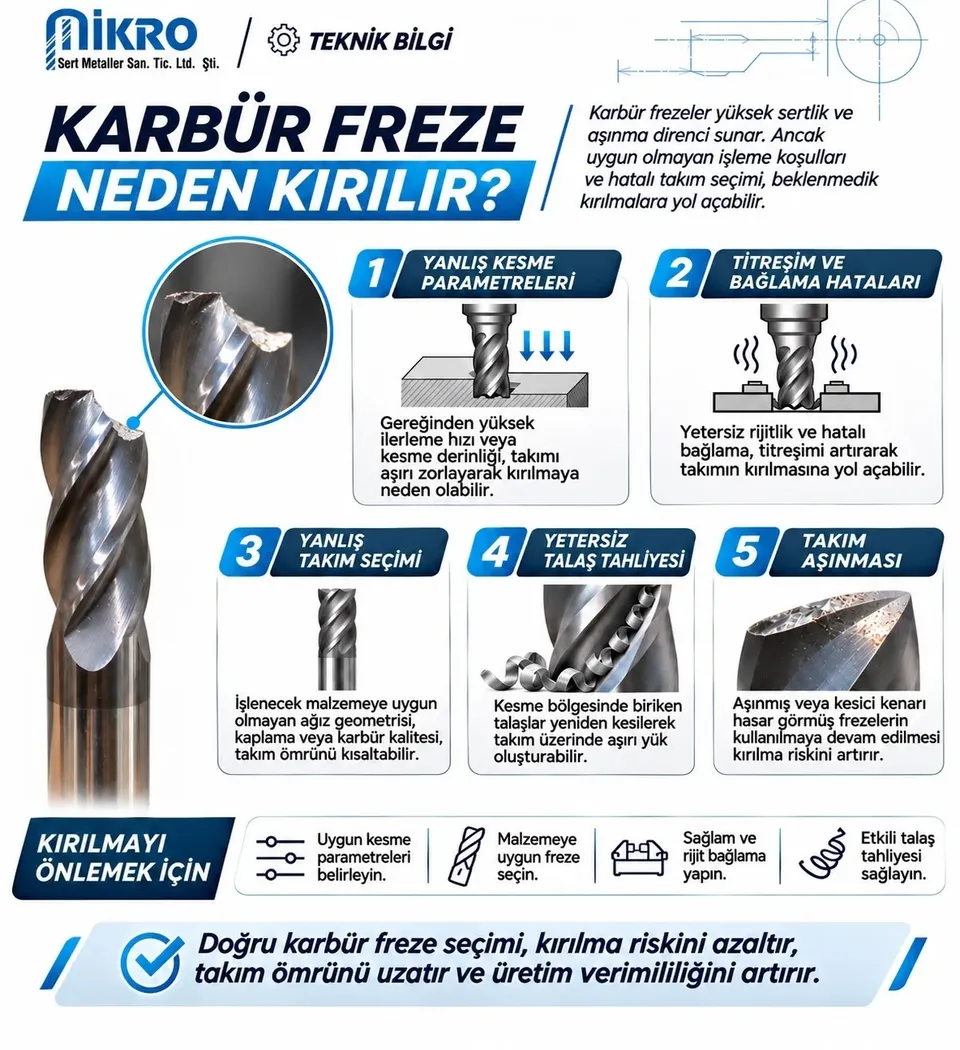
Carbide is not always the right choice. Hard metal is hard but brittle; it does not withstand impact and vibration as well as high-speed steel. If your machine is not rigid, the workholding is weak or the cut is interrupted, high-speed steel may be the smarter option.
| Situation | Suitable tool |
|---|---|
| Rigid CNC machine, series production | Carbide |
| Jobs requiring high cutting speed | Carbide |
| Hardened material (above HRC 45) | Carbide (hard series) |
| Vibration-prone, flexible clamping | High-speed steel |
| One-off, low-volume job | High-speed steel is often sufficient |
Where carbide end mills are used
Carbide end mills are not made for a single material. The geometry changes with the material being machined, and this difference directly determines performance:
- Aluminium and its alloys. A geometry with few flutes, wide chip flutes and a high helix. Aluminium is sticky; chips must be able to leave the flute freely. Carbide end mills for aluminium are a separate series for this purpose.
- Plastics, PVC and composites. Usually a single-flute, very sharp geometry. The aim is to cut the material without melting it. Requests for carbide end mills for PVC and carbide end mills for wood mostly fall into this group.
- Wood and MDF. An abrasive material; high-speed steel dulls very quickly. This is where carbide shows its tool-life advantage most clearly.
- Steel and cast iron. A geometry with many flutes, a lower helix and a heat-resistant coating.
- Mould steel. Hardened material requires a separate “hard series”.
Five dimensions to check when selecting a tool
1. Cutting diameter (d1)
It determines the size of the slot or corner to be machined. As the diameter gets smaller, the tool becomes more slender; feed and depth of cut must be reduced accordingly.
2. Number of flutes (z)
Rule of thumb: few flutes (2–3) for soft and sticky materials, many flutes (4 and more) for hard materials. The more flutes, the narrower the chip flute; in aluminium this means clogging.
3. Helix angle
A high helix (40–45°) evacuates chips upwards faster and leaves a cleaner edge; a low helix (30° and below) makes the cutting edge stronger.
4. Coating
A coating extends tool life, but if chosen wrongly it works against you. For aluminium, coatings that reduce adhesion stand out; for steel and cast iron, heat-resistant coatings.
5. Shank standard and tolerance
The shank diameter determines how the tool seats in the collet. The DIN 6535 HA plain shank is the most common standard. The tighter the shank tolerance (such as h6), the lower the runout; as runout decreases, both surface finish and tool life improve.
How long does a carbide end mill last?
It would be wrong to give a single number; tool life depends on the material, the cutting parameters, the cooling and the rigidity of the machine. The following generalisations are safe, however: a carbide end mill running with the right parameters lasts several times as long as high-speed steel on the same job and, as long as its body remains intact, can be reground. The diameter decreases slightly after regrinding; having this value measured and reported matters, so that you can adjust your machine program accordingly.
How is a carbide end mill made?
The process begins with mixing and pressing tungsten carbide and cobalt powders. The pressed rod is sintered at a temperature close to the melting point of cobalt; at this stage the grains lock together. The resulting rod is so hard that it can no longer be turned, only ground.
That is why carbide end mill production is a grinding job. Multi-axis CNC grinding machines use diamond wheels to grind the chip flute, the clearance angle and the cutting-edge geometry into the rod in a single clamping. Machining in a single clamping is important: if the tool is clamped more than once, each clamping adds a new positioning error and the uniformity between the cutting edges is lost.
Before the geometry reaches the machine, it is verified in digital simulation software. Especially for tools with special geometries, this step eliminates the need to produce the first part by trial and error.
Cost per part, not tool price
A carbide end mill is more expensive than a high-speed steel end mill. However, the right comparison is not the tools’ price tags but the total cost of machining one part. Three items go into this calculation:
- Tool cost / number of parts. Carbide is expensive but machines far more parts.
- Machine time. Because carbide runs at higher speeds, the machine minutes per part go down. In most shops, an hour of machine time costs more than the tool.
- Downtime. Every tool change is a stoppage; setup, measurement and first-part inspection are part of it.
When these three items are calculated together, carbide comes out ahead in series production almost every time. For one-off jobs, however, high-speed steel may still make sense.
Frequently asked questions
Are a carbide end mill and a hard metal end mill the same thing?
Yes. “Sert metal” (hard metal) is the Turkish term for tungsten-carbide-based cutting-tool material; in English-language sources it appears as solid carbide.
Can a carbide end mill be used on any machine?
It can, but it shows its efficiency on rigid machines with sufficient spindle speed. On a low-speed, vibration-prone machine, the advantage of carbide does not come through.
Can I have a carbide end mill made to custom dimensions?
Yes. A technical drawing or the dimensions of the part to be machined are enough; diameter, length, number of flutes, radius and helix angle are determined to your requirements.
Can a worn carbide end mill be reground?
Tools with an intact body can be reground to their original geometry. This makes a significant cost difference compared with buying a new tool.
Carbide end mills in Istanbul
Our production is located in Başakşehir, Istanbul, close to the İkitelli and Küçükçekmece industrial zones. In addition to standard sizes, we manufacture tools with special geometries and offer regrinding and recoating of worn tools. You can review all the size tables in our digital catalogue, and contact us to work out together the right geometry for your needs.